Flash Sale Color Icons: Streamlining Design Workflows with Vector Assets
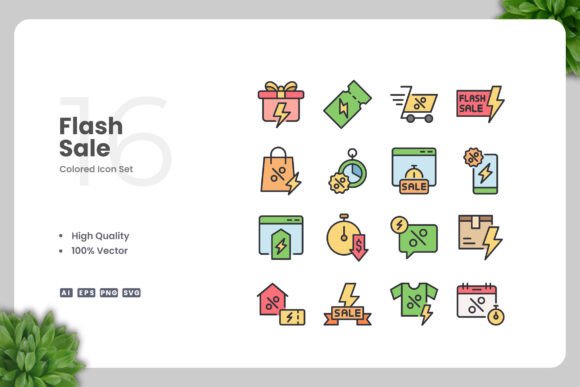
For designers, marketers, and content creators, the gap between a solid concept and a finished product is often filled with repetitive tasks: sourcing icons, adjusting colors, resizing files, and checking compatibility across platforms. A single project can require dozens of visuals for a website, a mobile app interface, a social media campaign, and a printed flyer. When deadlines are tight, having a reliable, flexible asset set can transform that process from chaotic to efficient. Flash Sale Color Icons are crafted exactly for this purpose: a collection of 100 vector icons designed with a clean, simple aesthetic, ready to drop into any workflow and adapt to a brand's specific needs.
This article walks through how these icons fit into real-world projects, from initial planning through final delivery. Whether you are a freelancer building a client pitch, an entrepreneur preparing a launch, or an educator assembling infographics, understanding the practical integration of such assets helps you work smarter, not harder.
What Flash Sale Color Icons Are and Where They Fit
Flash Sale Color Icons are not just a set of decorative graphics. They are a process tool—a building block that can be inserted into virtually any design or content production pipeline. The collection includes 100 unique icons, each delivered in multiple formats: source files in Adobe Illustrator (AI) and EPS version 10, as well as SVG and PNG with transparency. This variety means you can use the icons for both screen and print without re-creating them from scratch.
The "Flash Sale" theme itself suggests urgency and discounts, making the icons particularly useful for ecommerce promotions, limited-time offers, countdown timers, shopping cart interfaces, and marketing banners. But the clean style—solid color fills, simple outlines, minimal details—also works for broader applications: app dashboards, instructional infographics, blog post visuals, book illustrations, and even presentation slides. The design language is neutral enough to suit professional corporate branding yet vibrant enough for playful social media graphics.
Where do they fit in a broader process? Think of them as a mid-project resource. You might start with wireframing and content strategy, then move into visual design. Instead of drawing each icon from zero, you pick from this curated set, adjust colors, rescale, and place them into your layout. This cuts down the "graphic sourcing" phase significantly, freeing time for higher-level decisions like composition, typography, and messaging.
Before the Project: Preparation and Asset Planning
Efficient workflows begin before the first file is created. When you know you will need icons for a campaign or product launch, preparing your asset library ahead of time saves days of last-minute searching. Flash Sale Color Icons can be previewed in the provided PNG files or opened directly in vector software. At this stage, you might categorize the icons by theme: shopping, time, pricing, communication, etc. This mental or digital map becomes your quick-reference index during active design.
Additionally, checking compatibility is straightforward. The source files (AI and EPS) work in Adobe Illustrator and CorelDRAW, while SVG and PNG are universal. If your team uses Sketch, Figma, or other tools, you can import the SVG files or copy/paste vector data. The readme.txt file included in the download provides a quick overview, so you can confirm format support before committing to the set.
During the Project: Active Implementation and Customization
This is where the icons earn their keep. Imagine you are building a landing page for a flash sale: you need icons for "50% off," "free shipping," "limited stock," and "best seller." Instead of hunting through stock libraries or drawing each icon, you open the AI file, locate the relevant icons, and drag them directly onto your artboard. Because the icons are fully vector, scaling them up or down takes one click—no pixelation.
Color customization is a major time-saver. With vector software, you can select any icon's fill or stroke and change it to match your brand palette. The set is designed with clean color separation, so recoloring is as simple as picking a new swatch. This allows you to maintain consistency across all your marketing materials without creating multiple versions manually.
For mobile app designs, the SVG files are ideal because they remain sharp on retina displays and can be styled via CSS or inline properties. If you are working on print materials like posters or flyers, the EPS version 10 format ensures compatibility with older and newer versions of design software. The PNG transparency files are suitable for quick mockups or when you need a raster image without a background for social media posts.
After the Project: Archiving, Reuse, and Long-Term Consistency
Once the campaign launches, the icons do not become obsolete. You can archive the customized AI or EPS files as part of your brand’s visual library. Next time you run a promotion, you simply update the colors or copy the same icons to new layouts. This builds visual consistency across multiple campaigns, strengthening brand recognition. For agencies or in-house teams, maintaining a central icon set reduces the risk of misaligned graphics when different designers work on related projects.
Quality control also benefits. Because the source files are editable, you can fix any alignment issues, adjust stroke weights to match a new design system, or create derivative icons inspired by the original shapes. The long-term value lies in the ability to evolve your asset that came from this set.
Interaction with Tools, Resources, and People
Flash Sale Color Icons are designed to slot into existing workflows with minimal friction. Here is how they interact with your typical toolkit:
- Vector software (Illustrator, CorelDRAW): The AI and EPS files open directly. Layers are likely organized (based on standard Upnowgraphic collections), so you can easily isolate individual icons. Drag and drop is supported.
- Web and UI tools (Figma, Sketch, Adobe XD): Import SVG files. Because SVG is a web standard, you can paste the code into a React component, an HTML file, or a CMS rich text editor. For raster-based tools, the PNG transparency files serve as quick placeholders.
- Presentation software (PowerPoint, Keynote, Google Slides): Use PNG or copy/paste vector graphics. The clean design ensures they read well even when projected.
- Print production: EPS is a reliable print format. You can embed fonts if needed, but icons typically do not use text, so no font issues.
- Collaboration: When handing off to a developer or a print shop, providing the SVG or AI files is standard. The included readme.txt clarifies file use, which helps avoid confusion.
The icons also interact with your creative decision-making. Because the set is cohesive (same line style, same color palette), you can build a sense of unity across different media. For instance, the same "shopping cart" icon appears on a website, a mobile banner, and a physical flyer—tying the entire campaign together visually.
Example 1: Social Media Campaign for a Flash Sale
Your client wants a series of Instagram posts and Facebook ads highlighting daily deals. Using Flash Sale Color Icons, you select icons for "new," "sale," "clock," and "gift." Open the AI file, copy each icon into your social media design template, resize to fit, and change the colors to match the brand's red and gold. Save as PNG for upload. The entire graphics set for a week's posting is done in under an hour.
Example 2: Ecommerce App Interface
You are designing a mobile app for a discount retailer. The icons needed include a magnifying glass (search), heart (wishlist), bag (cart), and percentage (discount). Import the SVG icons into your Figma project. Because SVG supports CSS variables, you can later pass color overrides through a design token system. The simple geometric shapes mean they do not distract from the content.
Example 3: Infographic for a Marketing Report
An internal presentation requires an infographic showing "Before and After Sale" metrics. Use icons like "up arrow," "clock," "people," and "money." In Illustrator, scale and regroup. Add labels. The consistent line weight and solid fill make the infographic look professional without custom illustration.
General Implementation Tips:
- Organize your files: Once you download the set, rename the folder or create subfolders by category (e.g., "actions," "objects," "commerce"). This speeds up navigation.
- Test PNG transparency: Some software handles alpha channels differently. Confirm that the PNG files have transparent backgrounds before placing them on colored backgrounds.
- Use vector software for recoloring, not raster tools: Changing color in Photoshop may degrade quality or flatten layers. Stick with Illustrator, CorelDRAW, or other vector editors to preserve editability.
- Check EPS version 10 compatibility: While most modern software reads this format, older versions of CorelDRAW may need saving down. The included EPS is version 10, widely supported.
- Leverage the readme.txt: It may contain credits, terms of use, or shortcuts. Reading it saves troubleshooting time.
Factors That Influence Smooth Integration: Preparation, Compatibility, Usability
To get the most out of Flash Sale Color Icons, consider these factors before you start designing:
Preparation
Decide which icons you need before opening your project file. Skim through the provided PNG previews or open the AI file and browse the symbol palette. Create a shortlist. This prevents you from interrupting your flow to search mid-design. Also, confirm your software version supports the included formats. Illustrator CS6 or later, CorelDRAW X7 or later, and most SVG-capable apps work fine.
Compatibility
The vector files are platform-agnostic. If you work on a Mac and your colleague uses Windows, the EPS and SVG files transfer without issues. PNG transparency works on all operating systems. For web use, SVG files can be minified and embedded inline—no external assets required.
Usability
Because the icons are designed for drag and drop, you can literally open the file, select an icon, and drag it to another document. This reduces clicking through menus. The "easy drag and drop" promise holds true if you keep the source file open as a resource palette.
Efficiency and Organization
Using a single icon set for a project streamlines file management. Instead of hunting through folders of disparate icons, you have a single source with 100 options. Naming conventions (if the set uses descriptive filenames) help. You can also batch-recolor multiple icons at once using global swatches in Illustrator.
Consistency and Quality Control
Every icon originates from the same design system. This eliminates mismatched styles that can happen when pulling assets from different sources. For quality control, you can zoom in on the vector paths in Adobe Illustrator to ensure clean curves and no overlapping points. The provided high-quality design specification suggests professional construction.
Long-Term Use
Since the icons are vector, you can store the master source file on a cloud drive or internal server. As your brand evolves, you can quickly update the entire set's colors by editing the global swatches. The set can also serve as a foundation for creating icon variations—flip, rotate, combine elements. Over multiple projects, the icons become a familiar visual language that speeds up every design cycle.
Final Observations on Integrating Flash Sale Color Icons into Your Work
Design assets are only as valuable as the processes they support. Flash Sale Color Icons, with their clean lines, flexible formats, and easy customization, are built to reduce friction in the design workflow. They are not just "nice graphics"—they are a resource you can rely on before a project starts, during the intense creation phase, and long after the files are finalized.
The key is to treat them as a tool, not just a one-time purchase. Integrate them into your standard kit: keep the AI file in your assets folder, export SVGs for web, and maintain a library of recolored variations for recurring campaigns. When you approach each new project, ask yourself which of the 100 icons can serve your message, and then customize them to fit your context.
By adopting this mindset, you shift from scrambling for visuals to confidently building consistent, professional graphics across websites, apps, books, social media, infographics, flyers, print, banners, posters—and any other medium your work requires. The provided formats (AI, EPS, SVG, PNG) guarantee that no matter your chosen software or output, these icons will integrate smoothly.
For creators who value efficiency without sacrificing design quality, Flash Sale Color Icons offer a practical, process-oriented solution. Spend less time sourcing and more time making—that is the real value of a well-designed vector set.
Thank you to Upnowgraphic for delivering a resource that respects the way professionals actually work: with high-quality vectors, easy drag-and-drop, and the freedom to edit colors and sizes in any vector software. Have a great day, and may your design workflows be smooth and productive.